
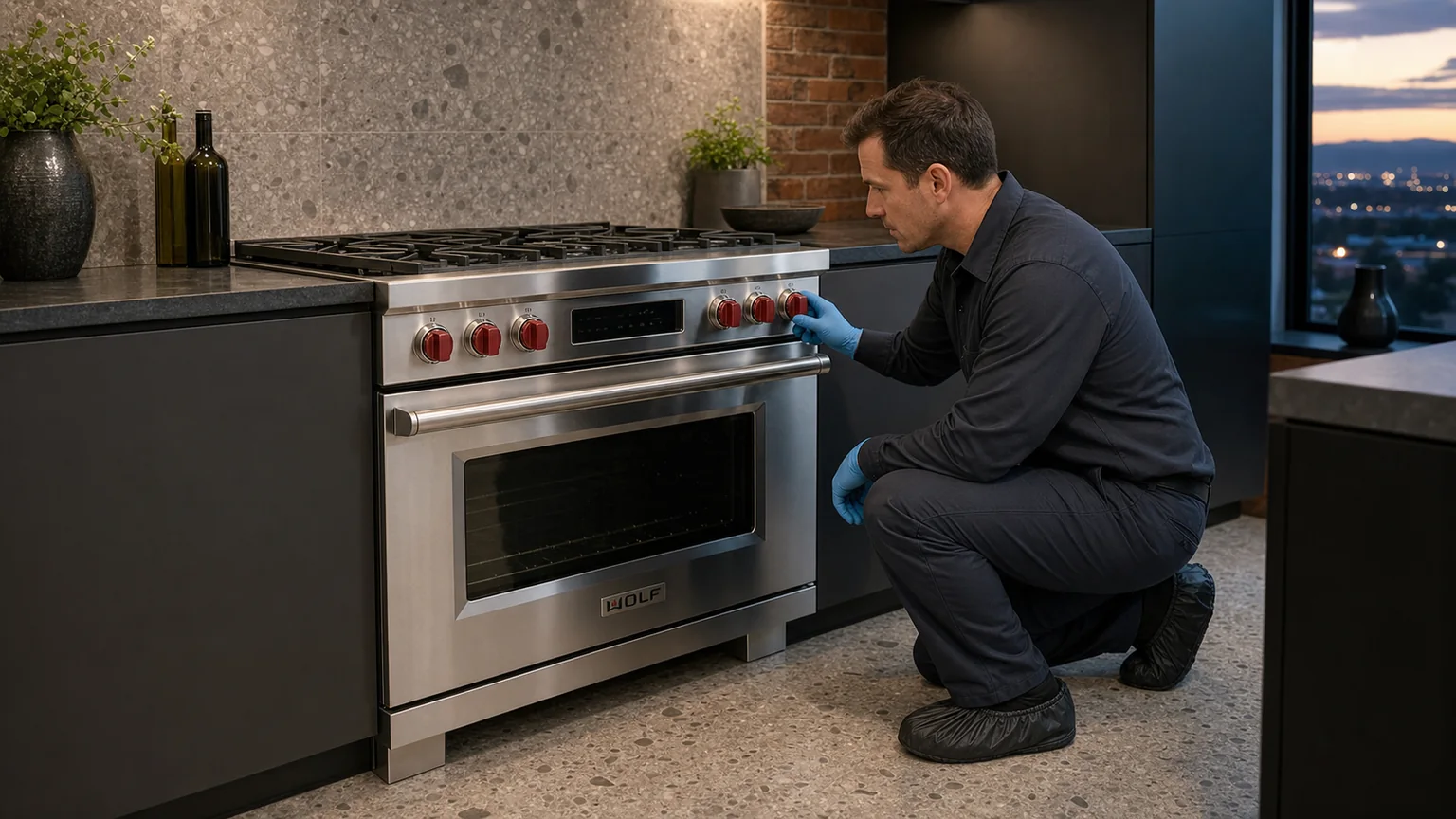
If you have moved to Highlands Ranch from a lower elevation, your recipes probably stopped behaving. Cakes fall, water boils faster but cooks slower, and bread proofs in half the expected time. None of that is an appliance fault. It is physics. But altitude also masks and mimics model-specific appliance problems, so it helps to know which is which before you call anyone.
Why Altitude Changes Cooking
At Highlands Ranch's elevation the air pressure is roughly 17 percent lower than at sea level. Water boils at about 202 degrees Fahrenheit instead of 212, so anything simmered or boiled cooks at a lower temperature and takes longer. Leavened baked goods rise faster and more violently because gas expands more easily in thinner air, which is why sea-level cake and bread recipes overshoot and then collapse. Sugar concentrates faster as well, so candy and syrup temperatures need adjusting. Your oven is doing its job correctly through all of this.
Baking Adjustments That Actually Work
- Raise oven temperature by 15 to 25 degrees to set the structure of a cake before it over-expands.
- Reduce leavening (baking powder or soda) slightly and cut sugar by a tablespoon or two per cup.
- Add a little extra liquid, since moisture evaporates faster in dry mountain air.
- Shorten proofing times for yeast dough and watch the dough, not the clock.
When It Is the Appliance, Not the Altitude
Altitude is a constant. If your oven baked acceptably for years and results suddenly changed, elevation is not the cause. A drifting oven that runs 30 to 50 degrees off, hot or cold spots, or long preheats point to a failing temperature sensor, a weak bake element, or a control board that has lost calibration. Those are real faults we correct with a meter and, where the model allows, a calibration offset.
Gas ranges at altitude can also show a genuinely lazy or yellow-tipping flame if the burners were set up for sea-level gas pressure. High-end ranges from Wolf, Viking, and others are commonly adjusted for altitude at installation; if yours was not, the burners may need the correct orifices or air-shutter setting rather than a repair.
| Symptom | Altitude or Fault? | What to Check |
|---|---|---|
| Cakes rise then collapse | Altitude | Adjust recipe, raise temp, cut leavening |
| Water boils but pasta stays firm | Altitude | Boil longer; the lower boiling point is normal |
| Oven suddenly 40 degrees off | Fault | Sensor or element test, recalibrate |
| Yellow, sooty gas flame | Setup or fault | Altitude orifice and air-shutter adjustment |
| Long preheat that never finishes | Fault | Bake element or relay check |
Refrigeration and Dry Air
Highlands Ranch's low humidity is hard on door gaskets and on any appliance with a water line. Gaskets dry and crack sooner here, and ice makers and dispensers see more scale because Front Range water is moderately hard. Cleaning condenser coils matters more in a dusty, pollen-heavy climate too. Those are maintenance items, covered in our brand guides, rather than defects.
Oven Baking Off in Your Highlands Ranch Kitchen?
If results changed suddenly, it is usually a sensor or element. Book a diagnosis. Diagnostic and travel fees, if applicable, are confirmed before the appointment and before repair approval.